
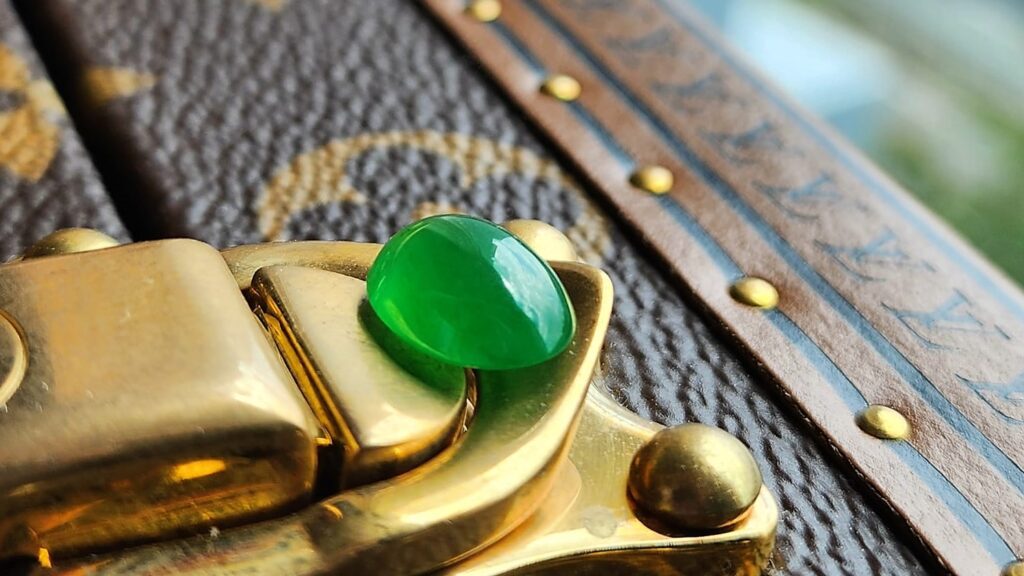
Originating from Myanmar, Asians have adored the finest jadeite for centuries. Its skyrocketing auction price has caught international collectors' attention, and many rushed to include it in their investment portfolios without hesitance. Being the world’s only source of top-quality jadeite, Myanmar’s political instability and suspension of mining operations have limited the jadeite supply, particularly the highly sought-after vivid green variety. Thanks to its interlocking crystal nature, Jadeite has more excellent resistance to breaking thanks to its interlocking crystal nature. It is hence a good choice for daily wear and a relatively better long-term investment than its green rival Emerald.
Jadeite originated from Myanmar and is regarded as one of the most valuable precious stones that could rival diamonds, ruby, sapphire and emeralds. This attributes not only to its beauty and scarcity but also to its skyrocketing auction prices over the years. However, being the only mining country of the finest jadeite in the world, Myanmar’s political instability and suspension of mining operations have made the supply sharply shrunken, particularly the highly sought-after vivid green variety.
Thanks to the nature of its interlocking crystal structure, Jadeite has strong resistance to breaking. Its toughness and durability have made it an excellent choice for daily wear and long-term investment compared to its green rival - Emerald.

Jadeite gems are said to possess health-strengthening abilities and improve longevity.(Blossom & Vicker)
The three most salient factors impacting market value are colour, transparency, and texture.
Colour evaluation standard: Saturation, Vividness, Evenness, Purity
Jadeite occurs in various colours, including green, lavender, yellow, red, black, colourless and more. Amongst these, green is the most highly prized, followed by lavender and colourless icy varieties. When evaluating the colour of jadeite, the Asian refers to the following criteria:
Nong (Saturation): The intensity and richness of the colour.
Yang (Vividness): The brightness and vibrancy of the colour.
Yun(Evenness): Most jadeite typically has uneven colour distribution. Therefore jadeite with uniform colour is rated much higher.
Zheng (Purity): The purity of the primary colour.
Type A, Type B and Type C Jadeite Classification
Type A refers to natural jadeites without any colour and clarity treatment. Type B refers to jadeite bleached with an acidic solution to remove impurities. Type C has been chemically bleached and then dyed to enhance colour.
While most traders proudly claim that their jadeite collections are natural Type A, plenty of Type B and C jadeites are still in the market. For decades, bleaching and polymer treatments were the standard industry practices to enhance the appearance of jadeites. This explains why jadeites passed down as family heirlooms often look dull and lacklustre.

Cufflinks first emerged in the late 17th Century, under the reign of King Louis XIV of France.. (Blossom & Vicker)
Transparency
Transparency refers to the amount of light passing through a piece of jadeite. As countless interlocking crystals form jadeites under high pressure, jadeites are not transparent, and their transparency ranges from entirely opaque to translucent. The finer the crystal size, the better the texture and hardness. Higher transparency indicates finer mineral crystals which show a brilliant lustre after the jadeite is polished.
Best collections: bangles, cabochon
Origin: Myanmar
Mohs hardness: 6.5 - 7
